
Demonstrating the ability of communities to lead in the delivery of healthier places
You will find here with detailed examples a compelling demonstration that, when properly supported, local people have the knowledge, motivation and capacity to deliver essential aspects of a successful neighbourhood health service.

WE SET OUT TO DISCOVER TO WHAT EXTENT LOCAL PEOPLE CAN...

...identify and take responsibility for their own health needs
...shape their environment and local services to address them
...be involved in delivery and long-term stewardship

WHY IS THIS IMPORTANT?
The Government’s 10 year plan for a ‘neighbourhood health service’ is proposing a shift from centralised, hospital-dependent care to localised provision focusing on prevention and on people taking greater responsibility for their own health. It is broadly supported, but to succeed it requires a fundamental shift in behaviour. We strongly believe this will only be achieved by leveraging the capabilities, resources and networks that already exist in places.
We need to think about health as something that we make rather than something that’s done to us
Current healthcare relies on top-down and often disjointed delivery, which is experienced by many as impersonal, slow and unequal.


WILL THIS CREATE A LASTING TRANSFORMATION?
We cannot address healthcare in isolation. Thriving places encompass people’s physical environment, their sense of belonging, their ability to contribute to decision-making and services. Self-determination, collaboration and trust are key.
Health must become the focus of development and regeneration and we must collaborate across sectors to achieve it.
This is the aim we share with a fast-expanding group – community and voluntary organisations, health and built environment practitioners, elected officials and public servants, funders and investors.
This is a place where people are health aware and mutually supportive; and where local services are focused, accessible and fairly distributed.

SO WHAT IF NEIGHBOURHOOD HEALTH SERVICES WERE SHAPED BY LOCAL PEOPLE?
By tapping into the capacity that exists within places – local knowledge, connectedness, mutual support – health and social care become rooted in local needs and therefore more focused, accessible and equitable. It helps to address health inequalities and the social causes of poor health, while bringing other social, environmental and economic benefits.
Prompted by need and innovation, there are already many successful examples: in peer-to-peer support; in improved uptake of services; in trusted partnerships between users and providers; in overcoming barriers to access. These successful projects are already contributing to places where people are health aware and mutually supportive. They are already demonstrating the potential to make services more focused, accessible and fairly distributed. But they are ad hoc and often starved of funding.
With proper support and resourcing,
community-led health will pay huge dividends

_edited.jpg)
OUR APPROACH:
PEOPLE AT THE CENTRE OF A VIRTUOUS CIRCLE
We have created a framework, expressed as a wheel of fortune and based on the evidence we have collected.
It reflects contributions from across community-led innovation and regeneration, health prevention and delivery, the built environment and investment. We have identified examples to illustrate how each aspect of community capacity can be unlocked, and to demonstrate successful community contribution to health improvement or delivery.
People are at the heart of any thriving place; they bring qualities that outsiders cannot provide. Their experience, motivation and leadership are the foundations on which change can be built. Putting people at the centre requires an understanding of how this local capacity manifests itself.
- Health and the place where you live are of universal importance
- local people provide lived experience, local knowledge and expertise
- they have a vested interest, are ideal stewards and will stick around
- their buy-in and involvement builds a sense of belonging
1
At the centre of the wheel of fortune we have placed people
_edited.png)
2
We have added the key ingredients that people provide to a sustainable community: Knowledge, connections, contribution.
local know-how gained through direct experience over time and available to be harnessed
social networks that reach deep into communities
people’s motivation, potential for innovation and ability to galvanise others


HOW CAN PEOPLE CONTRIBUTE TO BETTER LOCAL HEALTH OUTCOMES?
3
Wrapped round these are the three areas of opportunity and influence available to communities: organisation, health, space and place
the provision of inclusive governance at local and national level, to ensure both the input and influence of communities
the availability of high quality living and public environments which have a positive and sustained impact on people’s health
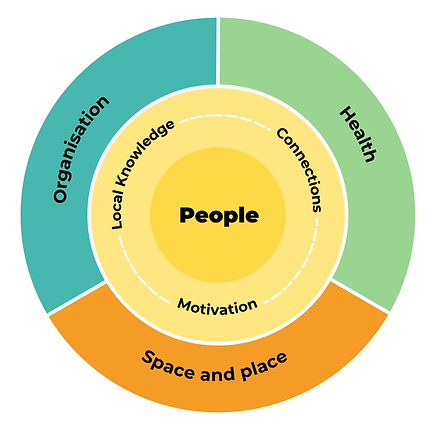
accessible and responsive healthcare, involving local people in prevention and delivery and enabling them to improve their own health outcomes
WHAT CONDITIONS ARE REQUIRED TO ENABLE THEM TO ACHIEVE THIS?


4
We have then included the particular conditions required for a community contribution to these areas to be achieved
local opportunities for improving health and awareness – providing mutual care, activities; promoting screening and rehabilitation


a better-educated community, aware of healthy living options and ready to buy in to local activities and services
readily accessible, flexible and coordinated services, informed by identified needs and shaped with local input
broad and well-communicated understanding among service providers of how policy and decisions play out on the ground
the will and resources for community involvement within local authorities and Integrated Care Boards
freedom to voice opinions and clear routes to influencing local decision-making

opportunities for paid employment, local enterprise and voluntary activity, increasing economic activity
opportunities for paid employment, local enterprise and voluntary activity, increasing economic activity
high quality, well-maintained homes, matched to local needs and a net positive to people and planet
accessible and cared for town centres and green spaces – shaped by and popular with local residents
CLICKING IN TO THE WHEEL OF FORTUNE
For each example, we demonstrate the local capacity identified and the outcome of harnessing that capacity...
We identified examples of community-led health services
STEP 1
We demonstrate the local capacity of communities in the examples
STEP 2
We also explore and evidence the outcome for neighbourhoods
STEP 3